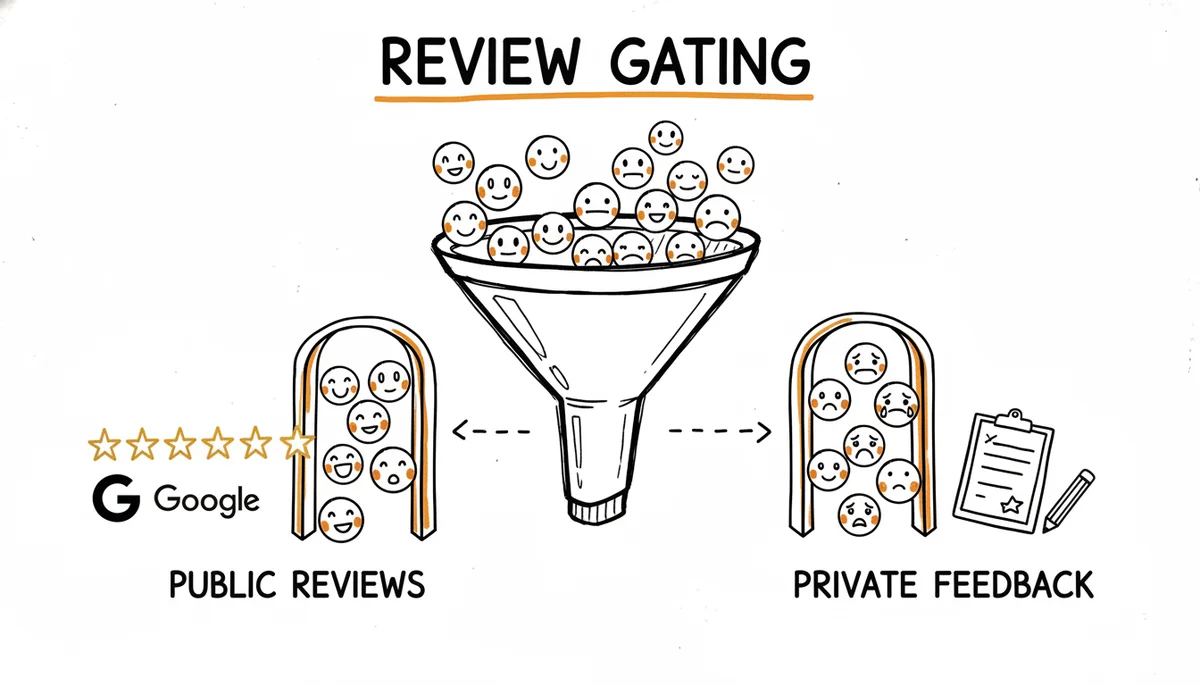
Review gating is the practice of asking customers for feedback and then selectively directing them based on their response. Happy customers get pointed toward a public review platform. Unhappy customers get routed to a private feedback form instead. The goal is straightforward: build your public review profile with positive experiences while handling complaints behind closed doors.
This article covers what review gating is, how the major platforms handle it, what enforcement looks like in practice, and how to set up a review gating workflow that minimizes risk.
What Is Review Gating?
Review gating means filtering who gets asked to leave a public review. The typical flow works like this:
- A customer receives a feedback request via email, QR code, or direct link.
- They click a star rating or answer a satisfaction question.
- If the rating is above a threshold (usually 4 or 5 stars), the customer is redirected to Google, Trustpilot, or another review platform.
- If the rating is below the threshold, the customer lands on a private feedback form where they can describe their experience directly to the business.
The result: public review profiles skew positive because unsatisfied customers are channeled elsewhere. The business still hears the negative feedback, just not in public.
How a Review Gating Tool Works
A review gating tool automates this entire workflow. Instead of manually asking each customer for a review, the tool handles the collection, routing, and follow-up. Here is what a typical setup looks like:
- Survey creation. You create a feedback survey with a welcome message, questions, and your review platform URL.
- Rating threshold. You set the cutoff. Customers who rate at or above this number get redirected to your review page. Everyone else sees additional feedback questions.
- Distribution. You share the survey via email (BCC method or direct send), QR codes printed on receipts or table signs, or a direct link on your website.
- Automatic follow-up. Customers who don't respond get a configurable reminder after a set number of days.
- Private feedback collection. Low-rating customers answer follow-up questions (free text, multiple choice, NPS) so you understand what went wrong.
The business sees all feedback in a dashboard. The public only sees the reviews that customers chose to leave on the review platform.
Google's Position on Review Gating
Google updated its review policies in 2018 to explicitly address review gating. Their policy states that businesses should not "discourage or prohibit negative reviews, or selectively solicit positive reviews from customers."
The key phrase is "selectively solicit." Google's position is that if you ask for reviews, you should ask all customers equally, not just the ones you expect will leave a positive review.
In practice, Google's enforcement is limited by what they can technically detect. Google sees the review being submitted on their platform. They do not see what happened before that moment. They cannot see that a customer clicked a 5-star rating on a third-party tool before being redirected. They cannot see that a 2-star customer was shown a feedback form instead. The entire pre-review workflow happens outside Google's visibility.
What Google can detect:
- Referrer patterns. If many reviews arrive from the same referring domain and those reviews are disproportionately positive, that is a detectable signal. This is why suppressing the referrer header matters.
- Review velocity spikes. A sudden jump from 2 reviews per month to 50 reviews per month looks unnatural, regardless of whether gating is involved.
- Identical review text. If customers copy-paste suggested review text, Google's spam filters will catch it.
What Google cannot detect:
- Whether a customer was pre-screened before being asked to review.
- Whether unhappy customers were offered a private feedback form.
- Whether the business used a review management tool at all, if the referrer is suppressed.
Has Google Ever Penalized Businesses for Review Gating?
Google has removed reviews in cases where gating was obvious. The known cases share common traits:
- The review request page contained text like "Only leave a review if you had a positive experience" or "Are you satisfied? Click here to review us on Google."
- The gating happened on a publicly visible page that Google could crawl.
- A competitor or disgruntled customer reported the practice with evidence.
There are no widely documented cases of Google penalizing businesses that use a private review gating tool with referrer suppression. The enforcement has consistently targeted visible, crawlable gating pages, not backend routing logic.
That said, absence of evidence is not evidence of safety. Google's policies are clear, and their enforcement could change at any time. The practical risk is low, but it exists.
Trustpilot's Position on Review Gating
Trustpilot takes a different approach. Their guidelines require that businesses using Trustpilot's invitation tools invite all customers, not a subset. They actively monitor invitation patterns and can flag accounts where the invitation-to-review ratio suggests cherry-picking.
However, Trustpilot's enforcement applies primarily to invitations sent through their own platform. If a customer arrives at your Trustpilot page via an external link (from your review gating tool), Trustpilot treats it as an organic visit. They cannot distinguish between a customer who found your Trustpilot page through Google search and one who was redirected from a feedback survey.
The risk with Trustpilot is lower than with Google because Trustpilot's detection mechanisms focus on their own invitation system, not on inbound traffic sources.
Yelp's Position on Review Gating
Yelp discourages all forms of review solicitation, not just gating. Their position is that businesses should not ask customers for reviews at all. Yelp's recommendation filter actively suppresses reviews it suspects were solicited, regardless of whether they are positive or negative.
This makes Yelp a poor target for review gating. Even if you route happy customers to Yelp, the reviews may be filtered out because Yelp's algorithm flags reviews from infrequent reviewers, reviews posted shortly after a transaction, and reviews that follow a solicitation pattern.
If your primary review platform is Yelp, a gating tool will have limited impact. Focus on Google, Trustpilot, or other platforms that are more receptive to invited reviews.
TripAdvisor's Position on Review Gating
TripAdvisor prohibits "selective solicitation" in their guidelines. Like Google, they want businesses to ask all customers for reviews, not just satisfied ones. TripAdvisor also runs a fraud detection system that analyzes review patterns, device fingerprints, and submission timing.
In practice, TripAdvisor's enforcement is similar to Google's: focused on detectable patterns rather than backend routing logic. A business using a review gating tool with referrer suppression would be difficult for TripAdvisor to distinguish from a business whose happy customers organically choose to leave reviews.
Is Review Gating Legal?
Review gating is not illegal. There is no law in the US, EU, or UK that prohibits routing customers based on their satisfaction level. The legal landscape to be aware of:
- FTC (US). The Federal Trade Commission requires that testimonials and endorsements reflect honest opinions. Review gating does not fabricate reviews. The reviews left by happy customers are genuine. The FTC's concern is with fake reviews, paid reviews, and undisclosed endorsements, not with choosing whom to ask.
- Consumer Rights Directive (EU). EU regulations require that review displays are not misleading. If you display reviews on your own website and only show gated positive ones, that could be considered misleading. However, reviews on Google or Trustpilot are displayed by those platforms, not by you.
- Platform terms of service. Violating a platform's ToS is a contractual matter, not a legal one. Google can remove your reviews or suspend your listing. They cannot fine you or take legal action for review gating.
The short version: review gating is a terms-of-service risk, not a legal risk. The consequences are limited to what the platform can do: remove reviews, flag your profile, or in extreme cases, suspend your listing.
How to Route Reviews Without Getting Flagged
If you decide to use review gating, these practices reduce the risk of detection and enforcement:
Suppress the referrer
The most important technical measure. When a customer is redirected from your feedback tool to Google, the browser sends a referrer header that tells Google where the customer came from. If that header contains your review tool's domain, Google has a direct signal. Setting a no-referrer policy on the redirect page removes this header entirely. Google sees the visit as "Direct." Learn how RateMind handles this.
Don't append tracking parameters
Some tools add UTM parameters or custom query strings to the review URL. These are visible to the platform and create a traceable pattern. Use the clean review URL with no additions.
Keep review velocity natural
If you normally get 5 reviews per month and suddenly start getting 30, that pattern is suspicious regardless of gating. Ramp up gradually. If you're sending 200 feedback requests per week, not all of them will convert to reviews at once.
Don't block negative reviews
The ethical (and practical) line: unhappy customers should still be able to leave a public review if they want to. Review gating offers them a better channel first, not an only channel. If a customer wants to leave a 1-star Google review after filling out your feedback form, that's their right. The point of gating is to give them a more productive option, not to silence them.
Encrypt customer data
If your review tool stores customer email addresses in plain text and that database is ever compromised, the data could theoretically be cross-referenced with review accounts. Encrypting customer data before storage removes this risk.
What RateMind Does Differently
RateMind is built for businesses that want to collect more positive reviews while handling negative feedback privately. Here is how it addresses the risks discussed in this article:
- No-referrer policy. Every page that redirects to an external review platform strips the referrer header. Google, Trustpilot, and other platforms see the visit as "Direct."
- No tracking parameters. Review URLs are passed through clean, with no UTM tags or custom strings appended.
- AES-256 encryption. Customer email addresses are encrypted before they reach the database. The dashboard shows masked addresses only.
- Gradual sending. The BCC email method and configurable invitation delays help maintain a natural review velocity.
- All customers are asked. Every customer who receives a feedback request gets to share their experience. Happy customers are offered a public review option. Unhappy customers get a private feedback form. Nobody is excluded from the process.
The result is a review strategy that is effective, private, and technically difficult for any platform to detect.
Ready to set up your review workflow? Create a free RateMind account and launch your first survey in 5 minutes.