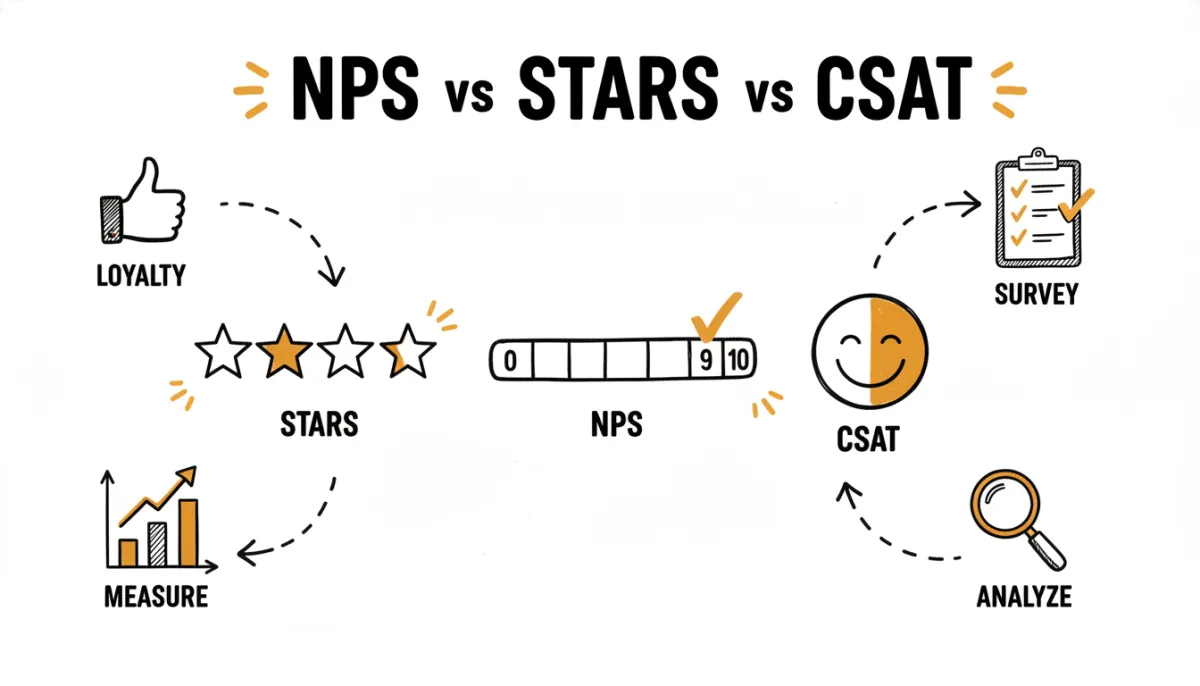
When you build a feedback survey, one of the first decisions is how to actually ask the question. Star ratings, an NPS score, a CSAT scale? They sound interchangeable, but each one measures something slightly different and works best in a different situation. Picking the wrong one gives you data that doesn't tell you what you wanted to know.
This is a quick, practical guide to the three most common feedback metrics, what each measures, and when to reach for which.
Star Ratings
The familiar one to five stars. It's the format people instinctively understand because it's everywhere: Google, Amazon, app stores. A star rating asks, in effect, "how was it overall?"
What it's good for: A fast, low-effort gut check on overall experience. People can answer in one tap, which means high response rates. It also maps directly onto public review platforms, so it's the natural choice when your goal is collecting reviews.
What it's weak at: Stars are blunt. A three-star rating tells you someone was lukewarm, but not why. On its own, a star rating gives you a number without a reason, which is why pairing it with a short follow-up question matters.
NPS (Net Promoter Score)
NPS asks one specific question: "How likely are you to recommend us to a friend or colleague?" on a scale of 0 to 10. Based on the answer, people are sorted into three groups:
- Promoters (9-10): loyal enthusiasts who will recommend you.
- Passives (7-8): satisfied but unenthusiastic, easily lured away.
- Detractors (0-6): unhappy customers who can damage your reputation.
Your score is the percentage of promoters minus the percentage of detractors, which lands somewhere between -100 and +100.
What it's good for: Measuring loyalty and the likelihood of word-of-mouth growth, not just one-time satisfaction. It's a strong predictor of whether customers will come back and bring others. Because it's a standard metric, you can benchmark your score against your industry.
What it's weak at: It measures intention to recommend, not the specifics of a single interaction. Someone can love your product overall but have had a frustrating support call last week. NPS won't catch that nuance unless you add a follow-up.
CSAT (Customer Satisfaction Score)
CSAT asks how satisfied someone was with a specific thing: "How satisfied were you with your support experience today?" Usually answered on a scale (1 to 5, or sometimes with smiley faces). Your CSAT score is the percentage of people who answered positively (the top one or two options).
What it's good for: Measuring satisfaction with a specific, recent interaction. It's perfect right after a support ticket, a delivery, or a purchase, while the experience is fresh. It pinpoints how a particular touchpoint is performing.
What it's weak at: CSAT is about the moment, not the relationship. A customer can be satisfied with today's interaction and still plan to switch to a competitor. It doesn't predict loyalty the way NPS does.
Quick Comparison
| Metric | Measures | Best moment to ask |
|---|---|---|
| Star rating | Overall experience | After any interaction, for reviews |
| NPS | Loyalty and word-of-mouth | Periodically, or after a key milestone |
| CSAT | Satisfaction with a specific touchpoint | Right after that touchpoint |
Which Should You Use?
You don't have to pick just one. The best approach often combines them:
- Use a star rating as the first question when your goal is collecting reviews. It's the fastest to answer and routes naturally to public platforms.
- Add NPS when you want to track loyalty over time and understand whether customers will advocate for you.
- Use CSAT after a specific interaction (support, delivery, onboarding) to measure how that touchpoint is doing.
The one thing all three share: a bare number is only half the story. Always pair the metric with a short open-text question like "What's the main reason for your score?" That's where the actionable insight lives.
Build Any of These with RateMind
With RateMind, you're not locked into one format. Every survey can use star ratings, NPS, single-choice, multiple-choice, yes/no, or free-text questions, and you can combine them. A common setup: a star rating as the opening question (which also handles the routing of happy customers to your review platform), followed by an NPS or open-text question for the customers who rate lower, so you learn exactly what to fix.
You get the review-collection benefit of stars and the deeper insight of NPS and CSAT, in one survey. Set up your first survey in 5 minutes.