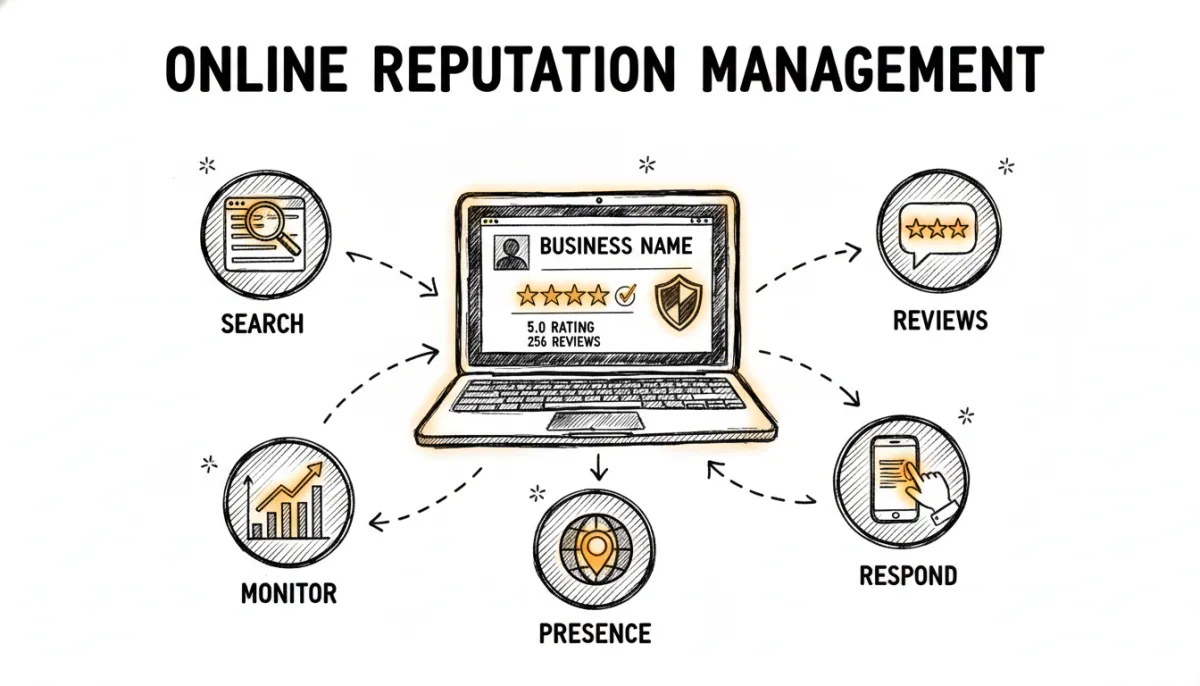
When someone hears about your business, the first thing they do is look you up. They search your name, glance at your star rating, skim a few reviews, and decide in seconds whether you're worth their time. That whole snap judgment is your online reputation. Managing it on purpose, instead of leaving it to chance, is what online reputation management is about.
The phrase sounds corporate, like something only big brands worry about. It isn't. A local cafe with 40 Google reviews has an online reputation just as much as a national chain does. The difference is that the chain has a team and a budget. This guide is for everyone else: a practical breakdown of what online reputation management involves and how to handle it yourself.
What Online Reputation Management Actually Is
Online reputation management (ORM) is the practice of shaping what people find when they look you up online. It pulls together a few different activities that all feed the same goal:
- Getting more positive reviews onto the platforms that matter
- Responding to reviews, good and bad
- Keeping an eye on what's being said about you
- Making sure your business information is accurate everywhere it appears
Notice that none of this is about hiding the truth or burying complaints. Good ORM isn't spin. It's making sure your online presence reflects the real experience your customers have, which for most honest businesses is a net positive that just isn't showing up yet.
Why It Matters More Than You Think
The numbers are blunt. Around 94% of consumers check reviews before buying. A one-star bump in your average rating can translate to a 5-9% lift in revenue, according to research out of Harvard Business School. And people don't just read the top review. They look at how many you have, how recent they are, and how you respond to criticism.
Your reputation also feeds your visibility. Google uses review signals as a ranking factor for local search, so a business with more and better reviews tends to show up higher on Google Maps. Better reputation leads to better ranking, which leads to more people seeing you, which leads to more reviews. It compounds. We go deeper on that in our guide to improving your Google Maps ranking.
The Five Levers You Can Actually Pull
1. Build Review Volume
This is the biggest lever, and the one most businesses underuse. If you never ask for reviews, the only people who leave them are the ones angry enough to seek out your page. That skews your rating downward and keeps your count low. Actively asking flips it. When you invite the large majority of satisfied customers to leave a review, your volume climbs and your average rises to match reality. Our guide on asking customers for reviews covers how to do this without being pushy.
Want to know how many reviews it takes to move your average? Our free Google Review Calculator shows exactly how many five-star reviews you need to hit a target rating from where you are now.
2. Catch Negative Feedback Before It Goes Public
Not every customer will be happy, and that's fine. What you don't want is the unhappy ones broadcasting their frustration on Google before you ever hear about it. The smarter approach is to give customers a private channel first. Ask for a rating, and route the unhappy ones to a feedback form where they tell you what went wrong. You fix the issue, follow up, and often turn a would-be critic into a repeat customer, all without a public one-star review. This is the whole idea behind RateMind: it asks for a rating, sends happy customers to your public review page, and quietly keeps the unhappy ones on a private form so you hear the complaint first.
3. Respond to Reviews
Responding shows future customers that you're paying attention. For positive reviews, a short thank-you is plenty. For negative ones, a calm, professional reply that acknowledges the issue and offers to make it right does more for your reputation than the original complaint does to hurt it. Around 45% of consumers say they're more likely to visit a business that responds to negative reviews. We have templates for responding to negative reviews if you want a starting point.
4. Monitor What's Being Said
You can't manage what you don't see. At a minimum, set up a Google alert for your business name and check your review profiles weekly. Bigger operations use monitoring tools that track mentions across review sites, social media, and the wider web. For a small business, a weekly check of Google, and whichever other platform matters in your industry, is usually enough.
5. Keep Your Information Consistent
Your name, address, and phone number should match everywhere they appear: your website, Google Business Profile, review sites, and directories. Inconsistent information confuses both customers and search engines, and it quietly drags down your local ranking. Pick one canonical version of your details and make everything match it.
DIY or Hire an Agency?
Online reputation management agencies exist, and for large brands facing a genuine crisis, they earn their fees. For a typical small or mid-size business, though, hiring one is usually overkill. The core work is straightforward: collect reviews, respond to them, keep your info accurate. You don't need a consultant to do that. You need a simple system and the discipline to keep it running.
The one place a tool genuinely helps is review collection, because doing it manually (remembering to ask every customer, sending links, following up) falls apart fast. That's where software earns its place, not by replacing your judgment, but by automating the repetitive part.
A Simple System That Works
Here's a setup that handles most of the five levers without much ongoing effort:
- Pick the one or two review platforms that matter most for your business (usually Google, plus an industry-specific one).
- Set up a way to ask every customer for feedback automatically, by email BCC, a review QR code, or a direct link.
- Route happy customers to your public review page and unhappy ones to a private form.
- Reply to new reviews once or twice a week.
- Check your profiles weekly for anything that needs attention.
This is exactly the workflow RateMind was built for. It handles steps 2 and 3 automatically: you ask for feedback, customers rate, and the routing happens on its own. Your review count grows, your average stays honest, and you hear about problems privately before they become public.
Online reputation management doesn't have to be complicated or expensive. Set up the system once, spend a few minutes a week on it, and your reputation starts working for you instead of against you.
Set up your first survey in 5 minutes to get started.